

Salome
Photograph from 1882 depicting the strange trio of people: Lou Andreas-Salome, Paul Ree, and Frederich Nietzsche. Andreas-Salome and Ree had devised a plan to set up a sort of literary/academic commune of sorts and after several months together, the then-unfamous Nietzsche joined the group, and eventually they travelled around Italy with Salome's mother. This scene, now over 100 years old, seems remarkable. Whenever there is a group of people that are now considered famous, it is always fascinating to try and reverse the spin of time and imagine them as they were together in the nowness of then: just people being people, unaware of their imminent immortality together. Salome in a horse cart, and the two men pulling her. It is hard to imagine these people laughing and being people now that Nietzsche's shadow is so prevalent in our world of Today. The friends eventually disbanded due to a quarrel of the typical sort: Salome presumed Nietzsche was madly in love with her and tiny garden of problems began to bloom. It's no bother - she would act as muse to some more impossibly famous people.
Later she had a celibate marriage to the linguist, Carl Frederich Andreas, whom I know nothing at all about - though the celibate marriage is of particular interest.
Her story eventually becomes legend as she starts meeting and connecting with several poets, philosophers, and other artists of her time. We have her to thank for Rilke's name, it was Salome's urging that prompted him to switch from the feminine Rene to the more masculine Rainier. They were lovers until his last breath, sharing a deep spiritual bond that transcended the bounds of social convention and as is the case with most artist-types the two eventually entered into a sort of meta-relationship wherein she fed Rilke language (teaching him Russian) while he in turn fed her poems. His career blossomed under her care, too, as she linked him to benefactors and art patrons with money to throw around blindly in the name of culture. By this point she was already becoming the archetypal "muse" as we know it today, and I wonder if she had a sense of this back then - she must have. To bind herself to the youthful Nietzsche the philosopher, then to Rilke the poet, and later to Freud the analyst - her list of men is impressive. It is amazing to have those branches spreading out from the same trunk and I wonder if she perhaps knew that each of these men would be the only ones in their field to last well on into posterity. Then, at the same time, if she is reduced to the common factor running through each of the men's histories, it could be said that she and not they is the special one: Nietzsche created Nietzsche, Rilke created Rilke, and Freud created Freud whereas Salome, she created all three!
What is even more fascinating (I swear, one day I will run out of fascination! Until then, be prepared for more gushings of astonishment) is what happens to the reader when he takes this breezy biography and superimposes it onto that of the biblical Salome, daughter of Herod. Even better would be to read those two stories with the famous Caravaggio painting stuffed in between the two blocks of text. The Salome of the New Testament is a symbol of the negative sides of female seduction, so nasty in fact that her naughty dancing and fickle behaviour lead to the eventual (and nonsensical) beheading of John the Baptist. Even as bad as she might have been, she (the Biblical Salome) managed to be muse to several artists centuries later: Flaubert and Wilde both wrote about her. Flaubert is a bit more sympathetic, and blames Salome's sinister mother for suggesting the beheading as some sort of political strategy while Wilde treats the story with his usual fancy by blaming John the Baptist himself, citing that it was his spurning Salome that prompted her to take such weighty measures and in the end she goes so far as to hold his head in her hands and deliver a sweet final kiss.
Later she had a celibate marriage to the linguist, Carl Frederich Andreas, whom I know nothing at all about - though the celibate marriage is of particular interest.
Her story eventually becomes legend as she starts meeting and connecting with several poets, philosophers, and other artists of her time. We have her to thank for Rilke's name, it was Salome's urging that prompted him to switch from the feminine Rene to the more masculine Rainier. They were lovers until his last breath, sharing a deep spiritual bond that transcended the bounds of social convention and as is the case with most artist-types the two eventually entered into a sort of meta-relationship wherein she fed Rilke language (teaching him Russian) while he in turn fed her poems. His career blossomed under her care, too, as she linked him to benefactors and art patrons with money to throw around blindly in the name of culture. By this point she was already becoming the archetypal "muse" as we know it today, and I wonder if she had a sense of this back then - she must have. To bind herself to the youthful Nietzsche the philosopher, then to Rilke the poet, and later to Freud the analyst - her list of men is impressive. It is amazing to have those branches spreading out from the same trunk and I wonder if she perhaps knew that each of these men would be the only ones in their field to last well on into posterity. Then, at the same time, if she is reduced to the common factor running through each of the men's histories, it could be said that she and not they is the special one: Nietzsche created Nietzsche, Rilke created Rilke, and Freud created Freud whereas Salome, she created all three!
What is even more fascinating (I swear, one day I will run out of fascination! Until then, be prepared for more gushings of astonishment) is what happens to the reader when he takes this breezy biography and superimposes it onto that of the biblical Salome, daughter of Herod. Even better would be to read those two stories with the famous Caravaggio painting stuffed in between the two blocks of text. The Salome of the New Testament is a symbol of the negative sides of female seduction, so nasty in fact that her naughty dancing and fickle behaviour lead to the eventual (and nonsensical) beheading of John the Baptist. Even as bad as she might have been, she (the Biblical Salome) managed to be muse to several artists centuries later: Flaubert and Wilde both wrote about her. Flaubert is a bit more sympathetic, and blames Salome's sinister mother for suggesting the beheading as some sort of political strategy while Wilde treats the story with his usual fancy by blaming John the Baptist himself, citing that it was his spurning Salome that prompted her to take such weighty measures and in the end she goes so far as to hold his head in her hands and deliver a sweet final kiss.
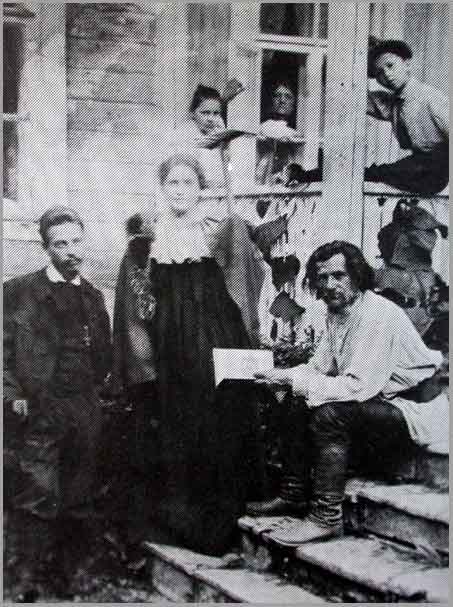 (Rilke and Andreas-Salome in Russia, with others)


