
Marriage
The Devil at the Hearth. From the Narodni Listy, January 18, 1923:
The question why all or almost all modern marriages are unahppy (as if only modern ones are unhappy and unmodern ones happy), is a question of style, a question at the center of a large, serious body of literature --- and of every unserious chat at five-o'clock tea. Any question in the world can be the topic of a casual conversation as well as the subject of a serious philosophical treatice, and we journalists, too, pick themes up, so to say, off the streets. But this is a question I wonder about incessantly, not because I'm incapable of explaining why modern marriages are unhappy --- what question would any journalist leave unchalleneged? It's really because I keep asking myself, again and again: Why should they be happy?
This is where it begins. Two people --- two small, lonely human lice at the mercy of life's many afflictions, general despair, and absence of prospects, two tiny human beings on this unimaginably, horribly, and disquieteningly enormous planet, each unhappy by birth, nature, and right --- are supposed to suddenly, all at once, at about 9:30am, while locked inside an apartment, a name, belongings, a fate, are supposed to be happy instantaneously, at a wave of the hand, simply because they are two?
The minute two people marry in order to be happy together they are robbing themselves of the chance to do so. It's just as selfish as to marry for happiness as it is to marry for two million, an automobile, or the title of baroness, and happiness won't make you any happier than the two million, the automobile, or the baron. If there's anything that avenges itself in this world, it is calculation and accounting in spiritual affairs.
The only good reason for two people to get married is if it is impossible for them not to. If they simply cannot live without eachother. no romance, sentimentality, tragedy: it happens. It actually happens daily and, whether it's love or not, it is decidedly the most legitimate and strongest feeling in the world. Except how many people overlook precisely that, repress it, reduce it, avoid it, break it?
Two people marry in order to live together. Why, in addition to the overwhelming, extraordinary gift of this oppurtunity, do they also need to be happy? Why can they never be satisfied with true, unadorned greatness, preferring the well-polished lie instead? Why do they promise each other something that cannot satisfy them, and cannot satisfy the world, nature, heaven, fate, or life, and which no one has ever been able to fulfill? Why do they expand a very real and realistic holy and worldly contract to include such a fantastic claim as happiness? Why do they demand from others more than they are able to give themselves, why do they demand anything at all, when faced by something as important, serious, and deep as a life together?
If we would consciously confront marriage before embarking on it, we would become aware of certain things we generally don't think about. For instance, that living together is not only easier, but also harder than living alone. Life alone has many compensations for the loneliness: half the responsibility or twice the freedom or independence or even the possibility of traveling to Australia. But marriage is difficult because, starting the moment one binds oneself, one must renounce everything --- in the deepest meaning of the word --- that marriage does not offer. And that is the secoud point where modern marriages break down: people marry without having positively decided for one another; or, to put it better, without having decided to renounce everyone else.
Getting to know someone is inconceivably difficult. I don't think I'm exaggerating when i say you can get to know someone after a half hour of conversation, but to know them any better takes another ten years of living together. I also think it's practically out of the question that two people could have the faintest notion who they are and whom they are marrying. Even if you know about all the great deeds, ideas, passions, convictions, beliefs, and confessions of the other person, you still don't know anything about his socks, his puffed-up eyes in the morning, his method of gargling while brushing his teeth, and his peculiar way of tipping the waiter. For what lies deep down is deceiving; but you can know a person by the surface. A thousand risks of disappointment are hidden in each marriage, as well as every possibility of internal collapse, and there is only one weapon against them: to take them on from the very beginning. Global convention requires that any intrinsic difference such as nationality or political or religious affiliation be forgiven in the name of love, and it is forgiven. But let us go deeper: let's forgive what's on the surface. Let's leave the modern hysteria ala Anna Karenina aside and forgive each other for ears that stick out and ties that are crooked. Every person is a world unto himself. The more he stands out, the more he creates a whole. The fewer opportunities or talents he has, the more significant they are. And if he only has one, then he's the most outstanding. But not sooner can you ask a blond man to have dark hair as well --- on Tuesdays and Fridays, for instance, for the sake of variety --- than you can expect a pedant to gladly dance a shimmy, a dimwit to understand Kierkegaard, a painter to understand mathematics, a melancholy man to sing a little song, or an eccentric recluse to throw a party.
That's easy to understand, and it's strange so few people do. They usually reproach one another for precisely those things which are determined by personality. It doesn't occur to them at all that being married really means accepting the other person so he will feel justified in being himself. After all, one person is always seeking confirmation of himself from the other. Proof that he is loved "nevertheless." Every one of us has such a "nevertheless" and that's precisely why we are unhappy. I will never believe that people live together because of sexual, erotic, pecuniary, or social necessity; people live together to have a friend. To have someone who will spare them from punishment, revenge, ill opinion, justice, or a bad conscience. Or do you really think a home is something else and serves purposes other than protecting, protecting, and once again protecting people from the world and mainly from their own inner reflection? The greatest promise that husband and wife can give eachother is that deep statement made, smiling, to children: I won't let you go. Doesn't that mean more than "I will love you unto death" or "I'll be faithful to you till death do us part?" I won't let you go. That says it all. Decency between people, honesty, home, loyalty, belonging, decisiveness, friendship. How infinitely vast such proises are compared with some miserable, shabby happiness!
In short, it almost seems to me that our marriages are so unhappy because we make it so damned easy for ourselves. It's very comfortable to accept a promise that can't be kept and then turn indignant and run away when the promise is broken a year later. I think it would be much more difficult to promise what can be kept, and then live up to such a promise. All the fantastic talk from the depths of one's soul is only an excuse; it won't survive the first truly difficult situation that demands simply that people act with human decency.
But why don't people promise eachother they won't scream when the roast is burned, or if one of them is late to dinner? Why don't they promise one another never to be too lazy to bring home an orange, a bouquet of violets, a superbrandnew Kohinoor pencil, of a bag of raisins? Why don't they proimse to show up at the breakfast table washed, smelling of soap and water, carefully dressed in clean clothes, even on the day after their golden anniversary and every day until then? Why don't they promise to hit eachother when they are angry rather than accuse one another of some minor atrocity, some little cowardice, some small repulsive act, or something slightly unappetizing? Why don't they promise eachother they'll look out for themselves and their own interests, regardless of whether these interests are for art history, soccer, or collecting butterflies? Why don't they promise one another the freedom of silence, of space, of being alone? Why don't they promise eachother these myriad difficult trifles, which can be fulfilled, and which are nonetheless constantly neglected, instead of promising something as incidental as happiness?
If marriage is to make sense it has to have a broader and more realistic basis than a longing for happiness. My god, let's not be afraid of a little bit of suffering, a little bit of pain and unhappiness. Try it, go out some night and stand face to face with the stars, look up carefully, sincerely and strain for at least five minutes. Or climb up some mountain where you can look down on the Earth almost as if you arein heaven. And after a while you'll find yourself believing in the imporance of life, and the insignificance of happiness. Happiness! As if being happy depended on us and us alone! As if there weren't a talent for being happy, just like there's a talent for singing, writing, politics, making shoes! You can give a person everything he desires, and still he won't be happy. And you can beat someone else until he can hardly breathe, and no sooner does he see a bunch of carrots, dripping with dew and fresh --- bright carrots with green leaves --- and he's already happy.
There are two ways to live: you can either accept your fate, make up your mind and cope with it, get to know your fate and bind yourself to its good sides and bad, to happiness and unhappiness, bravely, honestly, without bargaining, generously and humbly. Or you can seek your fate: but the search will not only consume your strength, time, illusions, instinct, and any proper, benevolent blindness; it will also consume your self esteem. You will become poorer and poorer, because what lies ahead is always worse than what you had.
Besides, seeking requires faith, and faith may require more strength than life.
--------------------------------------------------------------------------
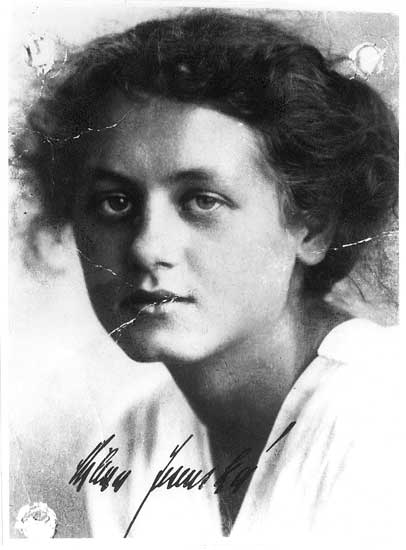
That was written by Milena Jesenska, Franz Kafka's last lover in his life. It is quite interesting to re-read, given this factual light that seems to bathe the thing in an eery sort of glow. This, of course, is drawing the conclusion unabashedly that she had Kafka in mind while forming this, writing this, sharpening this, and the more we allow ourselves the liberty to assume that a great and interesting feeling boils and bubbles up. Milena was married when she met Kafka. In 1921 (two years prior to the article on Marriage) she wrote this in a letter to Max Brod, Kafka's editor and seemingly dear friend:
"...And then it was just too late. The conflict within me became too clearly visible and that scared him. After all, that is exactly what he was fighting against his whole life, from the other side. But then it began to pursue him even with me. Against my will. I knew very well something had happened that couldn't be erased. I was too weak to be able to fulfill this task, to do the one and only thing I knew would help him. This is my fault. And you too know it's my fault. What people attribute to Frank's not being normal is actually his virtue. The women he was with were normal women and didn't know how to live any differently. I really think that every one of us, that everyone in the world, is sick, and that he is the only one who is healthy and understands things correctly and feels correctly and the only pure human being. I know he isn't resisting life, just this type of life. If I could have brought myself to go with him, he would have been able to live happily with me."
That last snippet was bolded, by me, and should ring a nice bell from the above article. In the two years that past between the letter to Max and the article on Marriage, Milena must have sharpened her focus a bit. It is nice, though, to see her image of Franz, "Frank", and to see her appreciation of him as the only pure human being. I wonder, though, what she was being too lazy for and why she thought she could have been the one to make him live happily? His happiness was her aim, and that seems to be the thing she is rejecting in her article. One gets a sneaking suspicion that she had to have him in mind when penning her article, and specifically not her own husband, the thing is too idealistic and so dismissive of the real: children and taxes and all the other actual burdens of a life together, the things she no doubt despised about her own real marriage. And, what about her claims to uphold these small sanctitudes, and protect the quiet of the other, and to above all what about "I won't let you go" and the fact that marrying someone is, in a way, renouncing all others. It's a bit pedestrian to call her "hypocritical", and I don't mean to do that, I just can't see how she could write so strongly about something when she herself, in her own personal life, married someone who she could not keep safe and in turn loved, wanted, and breathed for Kafka.
I wonder, though, had she gone and had she made Kafka's life happier, would a baby soon follow and would happiness be the aim again, instead of the promises one can actually keep as outlined in her article? It's a futile question, no doubt, and sticks out as particularily Kafkan in nature. He who wrote about a castle, the one idyllic image of the time free from the shackles and chains of the ever encroaching technology and totalitarian-administrationism that was just budding and growing amongst society, this perfect pastoral image invaded entirely by nameless beurocrats pushing papers in offices and forcing their will on a stranger. This Kafka, who saw even the old castle plagued by the deadly drones of clerks and computers: do we suppose he saw the institution of marriage as just another tradition being degraded by modernity? Its a safe one to assume, no doubt, and how much love did Milena have to swallow and digest sourly knowing that she simply could not infiltrate Kafka's own Castle, for it would ruin the quiet sanctitude of his inner rooms and force paperwork on him, amongst other more dangerous things.
In 1924, a year after her article on Marriage and just three years after writing to Max about how she could not bring herself to go with him and thus give him a happy life, she writes Kafka's obituary. It is touching, it is loving, it is written from the stance of: I knew him better than anyone else. She, being the only person who was close to him, who knew him in only the way a love could have known him... I see the obituary as most degrading, personally, as it sort of dresses his corpse up in bad makeup, too much rouge on the cheeks, too much powder on the brow, and he starts to look like a normal person who was loved dearly by this lady. For me, the only true obituary that should have been written for Kafka would have simply been to stand on a stage in front of the world and then to lift a fist heavenward and shake it vigorously.
Yes, we've now thoroughly gotten off the track of Marriage. Simply scroll yourself up to the article, disregard my own comments, and enjoy a perfect snapshot of what it should be.


