


DeYoung Museum
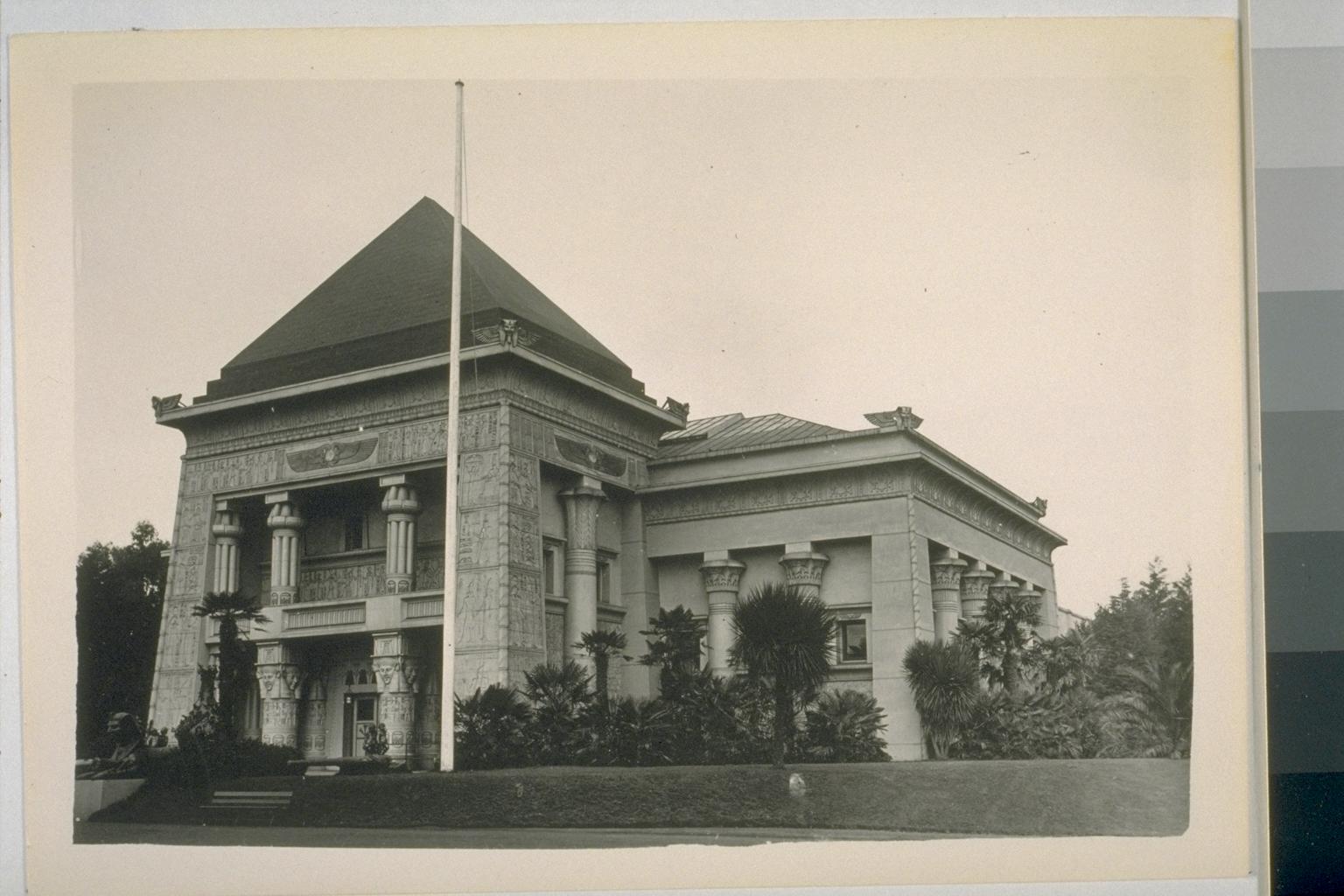
Top Photo: original building's main structure with Egyptian motif along the facade, circa early 1900's. A more Spanish influenced portion was added around 1916 as well, though not pictured.
Architecture changes a lot for a lot of reasons. The 1906 earthquake caused most of San Francisco to crumble, and what did not crumble caught fire shortly after and what did crumble caught fire as well causing one of the largest architectural losses to date. Entire neighborhoods were leveled, city-blocks uprooted like trees in a tornado, and what could still stand got burnt to ash. These natural architectrocides are sad enough when they're done to us, and even harder to get past when they are brought on by our own hands. The DeYoung Museum sticks out as a building that was demolished for no good reason only to be built back up again to the dismay of the majority of people in the city (the usual cries could be heard from the detractors: what was so wrong with the old one?) In summation: a pristine, modest, and still-useful thing has been replaced by a newer, more difficult, and alien-looking thing, and why? at what cost to the landscape? at what cost to our eyes? When the new DeYoung opened it did so with an all night party where all of the intellectuals, artists, and thinkers of the city and beyond were invited --- it seemed as though it were a spaceship masquerading as a building and the party was simply a launching whereby all of the most creative creative-types quit the city in favor for space. It felt like that, some sort of tractor beam must have been at play to get all of these thinking-peoples to accept this inhuman monstrosity as their DeYoung.
It also felt weird, to me, that this place would be changed and kids that go on field trips would have to deal with that. Having been a kid, and gone on the field trip once before as a 6 year old, the museum simply felt right. The park is ancient, the concourse containing the museum (as well as the science museum, surrounding gardens, and music pavilion) was all perfectly classic in its styling: Doric and Corinthian embellishments all done in marble, rock and concrete from the earth and of the earth, things that in themselves represent what museums should represent: timelessness, class and a sense of being unfathomably old. A huge boulder is just a huge thing, more so than some hyper-designed, overly wrought work of plastic, LED and man made metals. Sure - plastic, metal and glass are all things too, and they can be touched and felt and they can even inspire feelings in the viewer all there own --- but there is just something palpably different and unimpressive, to the eyes and fingers of a 6 year old, about these. Rocks just carry a bit of wonder in them, and the buildings built from the material have that wonder inherent in them, too. Imagine if Holden and Phoebe had their wonderful National History Museum stripped of its permanence in that park and its musty smells, and replaced with something new, modern and technologically savvy... indefinably sad! When the museum started undergoing construction, these were the first thoughts that flooded my head: what will the new building mean to these new kids with their new eyes and their new fingers? And: how will that shape them, assuming it will shape them as the old buildings shaped generations of kids? And, lastly: do kids even notice the grammar of buildings and relate that to their own feelings? Museums are our modern monuments, and monuments seem less epic the more they are touched and constructed by man. We've been shaping stones for thousands of years, and with that much momentum of time the process itself has also become a monument (to the past.) so in that regard, the means with which these museums are made must be considered. I understand that copper is a naturally occuring thing in the world, but the sheets that create the skin for the new DeYoung sure looked fashioned by the hands of man. If the two museums happened to be drinking in the same bar, the new DeYoung would be the set of early 20-year olds who prance about in their father's clothes dancing to their father's music, whereas the old DeYoung would simply be the father: authentic and never a try-too-hard. The old building just looked proper, and I know the earth surrounding it didn't plot to technologize it and I have a hunch that it wasn't the trees or the surrounding city that decided it was outdated and in need of renovation. Poor old man, he's been kicked out of his grave to make room for some newly dead corpse.
It also felt weird, to me, that this place would be changed and kids that go on field trips would have to deal with that. Having been a kid, and gone on the field trip once before as a 6 year old, the museum simply felt right. The park is ancient, the concourse containing the museum (as well as the science museum, surrounding gardens, and music pavilion) was all perfectly classic in its styling: Doric and Corinthian embellishments all done in marble, rock and concrete from the earth and of the earth, things that in themselves represent what museums should represent: timelessness, class and a sense of being unfathomably old. A huge boulder is just a huge thing, more so than some hyper-designed, overly wrought work of plastic, LED and man made metals. Sure - plastic, metal and glass are all things too, and they can be touched and felt and they can even inspire feelings in the viewer all there own --- but there is just something palpably different and unimpressive, to the eyes and fingers of a 6 year old, about these. Rocks just carry a bit of wonder in them, and the buildings built from the material have that wonder inherent in them, too. Imagine if Holden and Phoebe had their wonderful National History Museum stripped of its permanence in that park and its musty smells, and replaced with something new, modern and technologically savvy... indefinably sad! When the museum started undergoing construction, these were the first thoughts that flooded my head: what will the new building mean to these new kids with their new eyes and their new fingers? And: how will that shape them, assuming it will shape them as the old buildings shaped generations of kids? And, lastly: do kids even notice the grammar of buildings and relate that to their own feelings? Museums are our modern monuments, and monuments seem less epic the more they are touched and constructed by man. We've been shaping stones for thousands of years, and with that much momentum of time the process itself has also become a monument (to the past.) so in that regard, the means with which these museums are made must be considered. I understand that copper is a naturally occuring thing in the world, but the sheets that create the skin for the new DeYoung sure looked fashioned by the hands of man. If the two museums happened to be drinking in the same bar, the new DeYoung would be the set of early 20-year olds who prance about in their father's clothes dancing to their father's music, whereas the old DeYoung would simply be the father: authentic and never a try-too-hard. The old building just looked proper, and I know the earth surrounding it didn't plot to technologize it and I have a hunch that it wasn't the trees or the surrounding city that decided it was outdated and in need of renovation. Poor old man, he's been kicked out of his grave to make room for some newly dead corpse.
The new building looks like a spaceship, but is better now thanks to the oxidation that has taken care of most of the outside envelope of copper. Eventually the patina will cloak the entire surface of the museum in a wonderful hug of nature and it will begin to seem rooted in its environment, but that is still a decade down the road. It lays low along the land, which is nice, and the tower twists up from the ground with a nice and interesting bend, tilting the lines with a nice curve. Walking through the museum has a sort of natural rhythm that all good museums should have (and that the MOMA should take note of, being impossible to walk "through"). The collections are old, and nice, and the lighting is handled in a particularly unobtrusive way. What thrilled me, upon a recent visit, was noticing how the building plays with the environment primarily through its use of glass and views. The glass opens segments of the walls of the museum, which provide the eyes with a pretty picture: angles that make for a not-unsteady bit of geometry in a tricky way. The building seems to have no right angles, so when you catch a glimpse of an exterior wall through an interior window what seems straight and normal ends up being angled a trifle which in turn provides for these stunning tricks of shape. The building seems to lean in ways and undulate, despite how heavy and thick it feels. Pictured above are several instances of this.
Probably not so specific to the museum, or to the material, but the glass windows themselves are beautiful, for lack of a better word. They allow light to contain itself, or spread depending, and are cut thick enough to provide reflection even when none should appear. Again, pictured above, these tricks of light and reflection/refraction play on the pictures provided by each window, or expanse of windows: a jumbled geometry made by the buildings and imposed on top of that, clearly, the windows' reflective power. Things appear in the windows that are actually not outside of them, they become mirrors depending on the ambient light in front of or behind them and though this phenomena occurs in my own living room every evening, to walk through a space so large with so many vantage points to enjoy, it is dizzyingly, dazzlingly different. So with the windows as mirrors there ends up being a layered effect to all of the views and the mind, with its tricked eyes, is always trying to differentiate between "here" or "there" and "thing" or "projection".
When I was trying to find old photos of what the former museum looked like, even though it was torn down no less than 5 years ago, they are exceptionally scarce. Searching the standard Google images for "DeYoung Museum" or "Old DeYoung Museum" turns up over 10 pages of results, of which only a precious 4 or 5 black and white images remain of the prior building. This flash of realization makes me fearful: the forgetfulness of the future. I try my best to accept this new building as new, and I don't hold a grudge that kids will forever be fooled by it, but despite all my trying I still can't come to terms with the fact that the old is not being honored here. Maybe that is what retrospective shows are for decades down the line, to show "Here is a history!" and no doubt it will be glossy, glossed-over, and succinct. And, I do understand that there are far better places for this sort of research than Google to go to in order to find out about the history of that museum --- but that's just the problem. The six year old today will not turn to his trusty wall full of encyclopedias, nor will he pedal his bike to the public library to do some reference hunting (gone are the joys of opening a creaky card catalog drawer and catching a whiff of that perfectly bookish odor), the kid today and tomorrow will simply "google it" and when they do, if they do, it'll be a sadly incomplete picture. I guess this is mostly a gripe about future generations, and not about old buildings and their history going extinct.
What scares me is the lack of relatability, and it seems that my slim little generation is often caught adrift between the Then back there and the Now that we are in the middle of. Caught in between --- a lot of us remember the monuments, have seen then demolished, and are now in the particularily odd position of being put through the hell of seeing the new things sprout up from the ground without the longevity of life to see them bud, and flower. I will be gone before the generation comes that appreciates this new DeYoung museum, and that is sad. I wasn't here long enough to enjoy the old one, and that is sad. A smarter philosopher would deduce that this has something to do with my own sense of mortality, that what I am really lamenting here is that I too will be demolished and perhaps my own memory won't carry forth throughout the ages to ring like the brilliant ding of a perfect bell --- and that maybe some future generation might deem mine obsolete, and in need of a facelift. If the shoe fits... but what I think I am worried most about is that when the old building was there, it was a way for me to relate to my Grandmother when she'd say "Have you seen the DeYoung?" I used to be able to answer: "Yes!" but now its as though the referrent has changed, behind both of our backs. She will always be referring to the old one, and from here on out the rest of the world won't be. Eventually the children growing up now, with this new one, will become grandparents themselves and maybe if they're lucky they will have some architecture to mourn, too. This must be one of those times that all humans are faced with where they have to choose whether to side with the past, in all of its established glory, or side with the future with all of its inevitable uneasiness. Feeling caught precariously inbetween the old rock and the new hard place, I can say that it does feel a bit like being caught on a bridge with a not so pleasant feeling. Time, oh time.
What scares me is the lack of relatability, and it seems that my slim little generation is often caught adrift between the Then back there and the Now that we are in the middle of. Caught in between --- a lot of us remember the monuments, have seen then demolished, and are now in the particularily odd position of being put through the hell of seeing the new things sprout up from the ground without the longevity of life to see them bud, and flower. I will be gone before the generation comes that appreciates this new DeYoung museum, and that is sad. I wasn't here long enough to enjoy the old one, and that is sad. A smarter philosopher would deduce that this has something to do with my own sense of mortality, that what I am really lamenting here is that I too will be demolished and perhaps my own memory won't carry forth throughout the ages to ring like the brilliant ding of a perfect bell --- and that maybe some future generation might deem mine obsolete, and in need of a facelift. If the shoe fits... but what I think I am worried most about is that when the old building was there, it was a way for me to relate to my Grandmother when she'd say "Have you seen the DeYoung?" I used to be able to answer: "Yes!" but now its as though the referrent has changed, behind both of our backs. She will always be referring to the old one, and from here on out the rest of the world won't be. Eventually the children growing up now, with this new one, will become grandparents themselves and maybe if they're lucky they will have some architecture to mourn, too. This must be one of those times that all humans are faced with where they have to choose whether to side with the past, in all of its established glory, or side with the future with all of its inevitable uneasiness. Feeling caught precariously inbetween the old rock and the new hard place, I can say that it does feel a bit like being caught on a bridge with a not so pleasant feeling. Time, oh time.
The glass, though, the glass windows are quite astonishing and I am glad that the place has a sense of place and that I can finally see that.
Afterword
Afterword
More photos of the DeYoung, as taken by yours truely, are encased here for posterity. The show was of Chihuly, who I was not at all excited to see which turned out to be surprisingly worthwhile.


